
The Holding Index™ Snapshot
FREE ASSESSMENT
Discover How Well Your Judgement Is Holding Under Pressure.
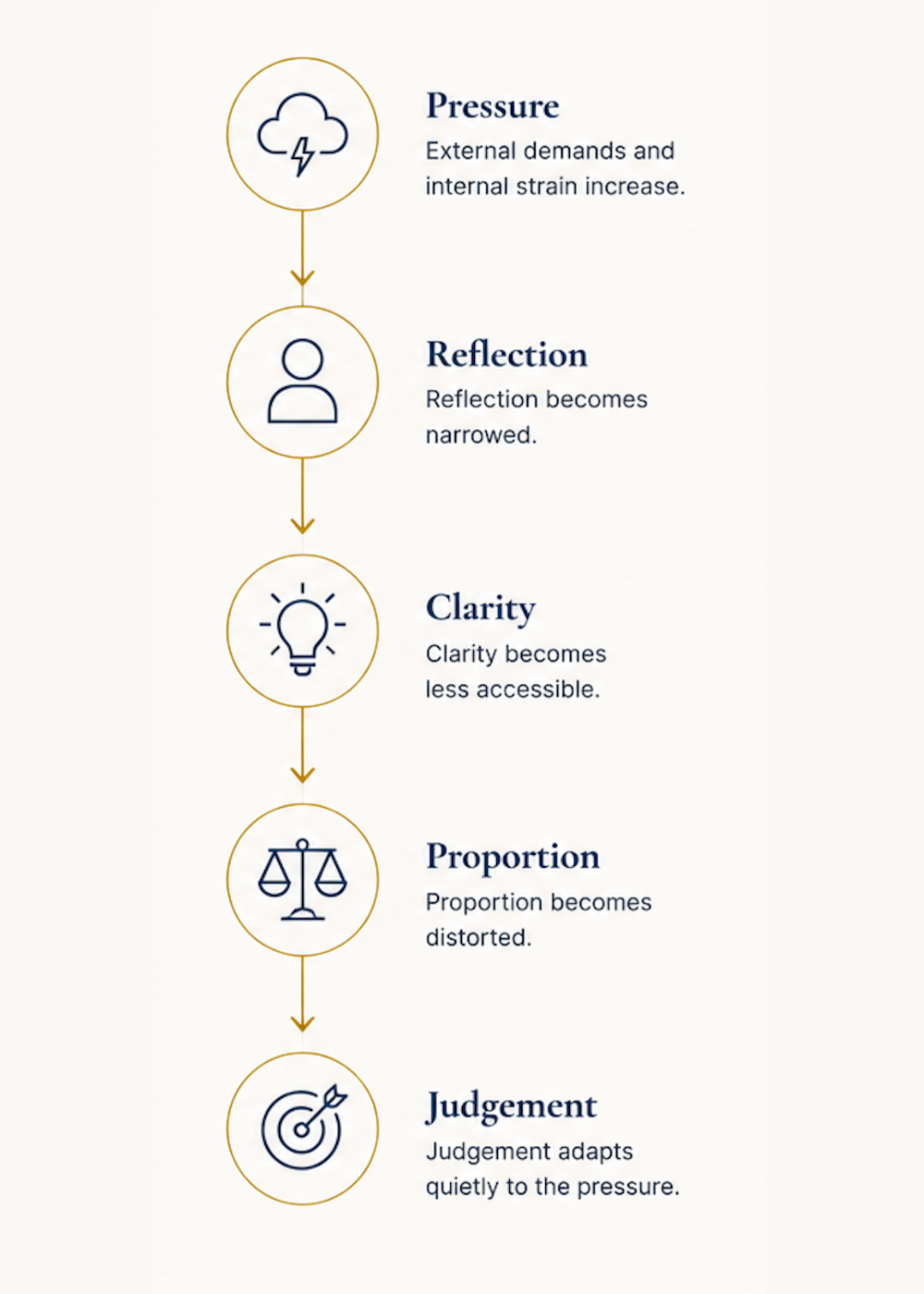
Pressure rarely distorts professional judgement all at once.
Its effects often appear gradually, reducing reflection, proportion, and clarity long before they become obvious.
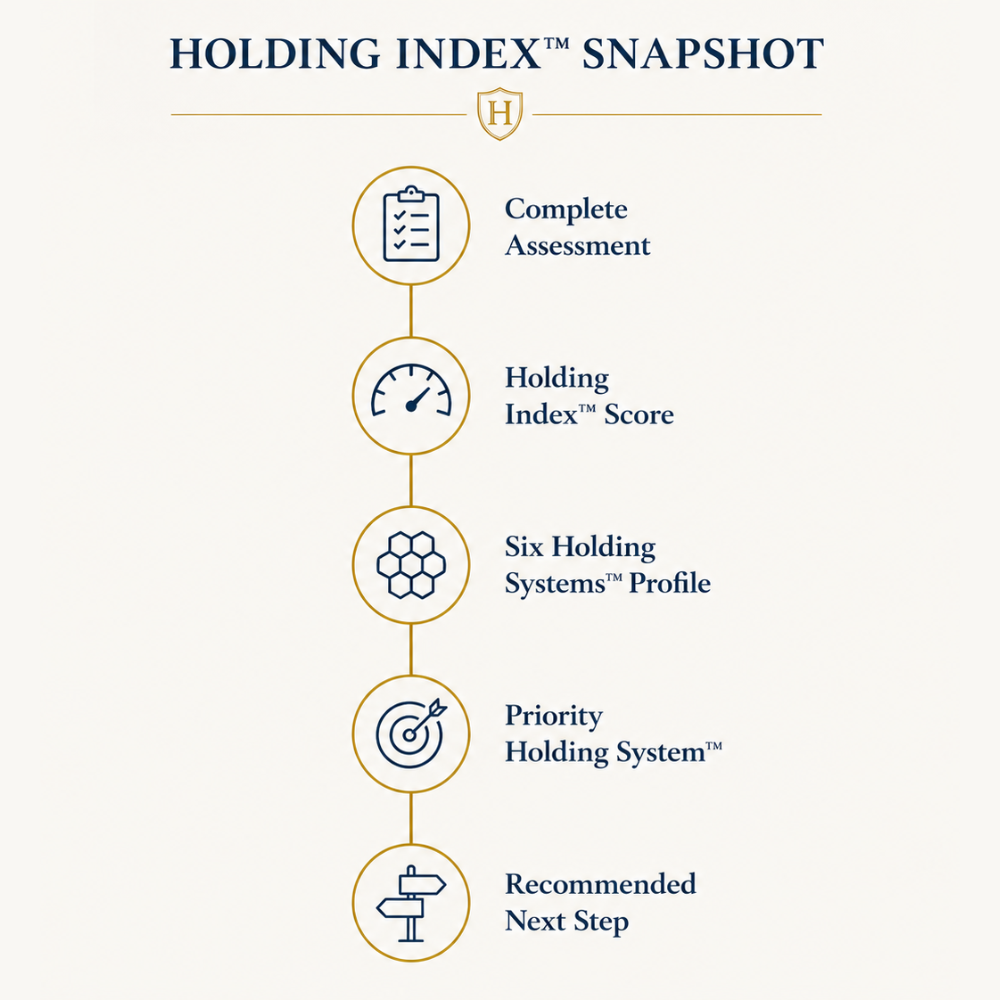
The Holding Index™ Snapshot provides a complimentary assessment that helps you recognise where your judgement is currently holding well—and identifies the most appropriate starting point for deliberate professional development.
✓ Complete the assessment in approximately 10 minutes.
✓ Receive your Holding Index™ Score.
✓ View your Six Holding Systems™ profile.
✓ Identify your Priority Holding System™.
✓ Receive a recommended next step for continued development.
Recognition becomes valuable only when it leads to deliberate development.
PAGE GUIDE
Explore the Professional Pathway
This page introduces the complete professional ecosystem of The Holding Discipline™.
Whether you are exploring certification, responsible deployment, ongoing membership, or professional governance, each section builds on the one before it.
Begin wherever your current questions are strongest.
The complete pathway becomes clearer as each section builds upon the previous one.
WHY THE HOLDING INDEX™
Professional Judgement Changes
Long Before Performance Does.
Most professionals recognise pressure only after its effects become visible.
By the time decisions feel heavier, priorities become blurred, or urgency begins replacing reflection, judgement has often been adapting quietly for some time.
The Holding Index™ was created to help recognise these changes earlier—before temporary pressure develops into sustained patterns that influence professional judgement.
The earlier these shifts are recognised, the easier they are to recalibrate before they become lasting patterns.
01

Judgement
Pressure rarely removes capability.
It more often narrows reflection, proportion, and clarity while capability appears unchanged.
02

Compression
Small shifts in judgement accumulate gradually.
Without deliberate recognition, they often become accepted as the new normal.
03

Recognition
Earlier recognition creates greater opportunity for recalibration.
The sooner compression is recognised, the easier it is to restore proportion and professional judgement.
The purpose of the Holding Index™ is not to evaluate who you are.
It is to help you recognise how pressure may currently be influencing the way you think, decide, and respond.
WHAT YOU’LL RECEIVE
What You’ll Receive Immediately After Completing Your Assessment.
The Holding Index™ Snapshot provides immediate awareness of how your judgement is currently holding under pressure. It is designed to create recognition rather than detailed diagnosis.
Within minutes, you’ll receive a structured overview that highlights where your judgement is holding well and where further development may be beneficial.
Each insight is designed to help you move from recognition to deliberate professional development.
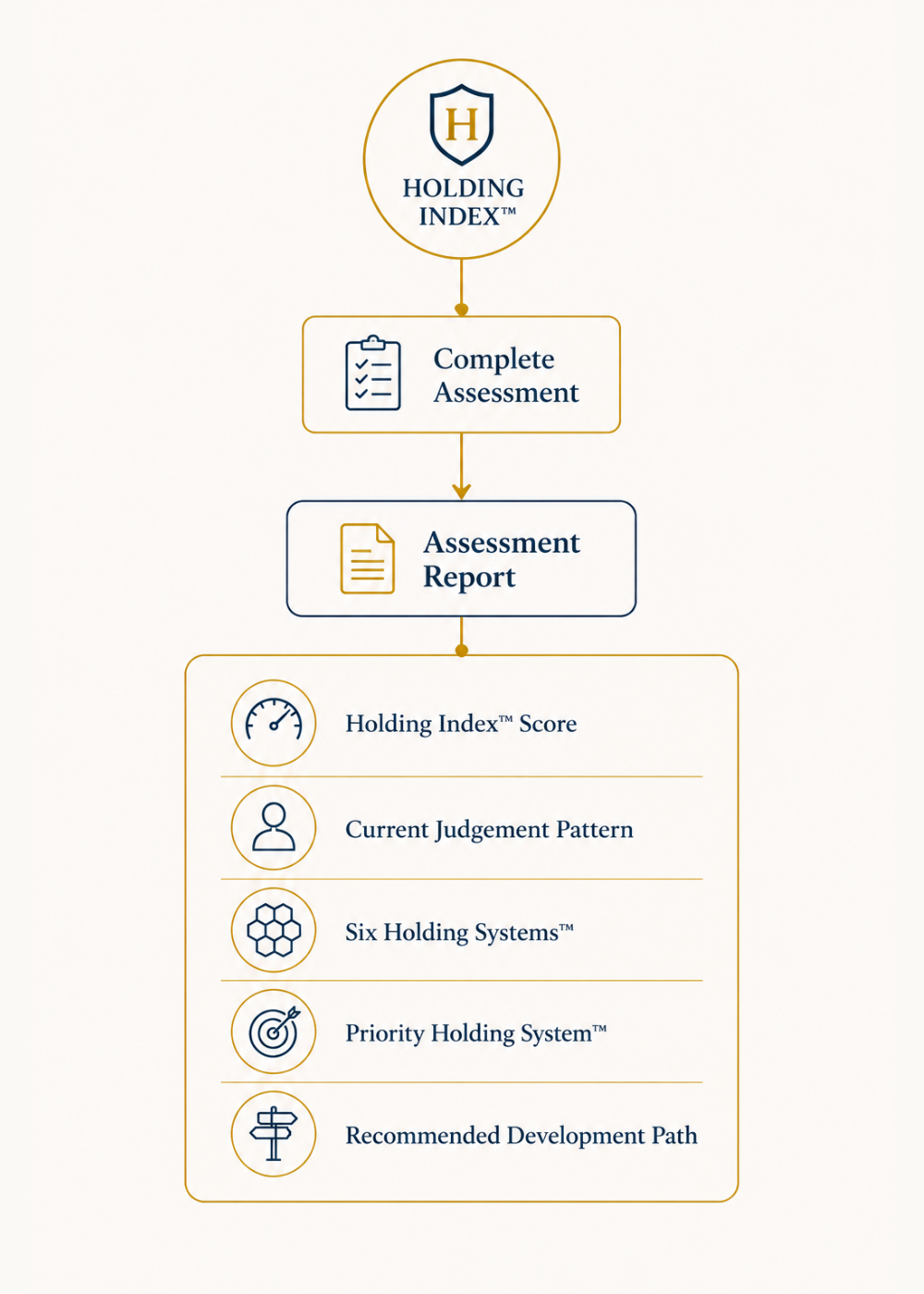
01
Holding Index™
Score
Receive your overall Holding Index™ Score, providing a clear indication of how consistently your judgement currently maintains reflection, clarity, and proportion under pressure.
02
Current Judgement Pattern
Understand whether your current judgement appears to be Holding Well, showing Early Compression Signals, Compression Developing, or Compression Affecting Stability.
03
Six Holding Systems™ Profile
See how pressure may currently be influencing judgement across the six Holding Systems™, helping you recognise which areas remain stable and which may require greater attention.
04
Professional Holding Profile
Receive a concise overview of your current judgement profile, highlighting strengths alongside areas that may benefit from greater awareness and development.
05
Priority Holding System™
Identify the Holding System™ where deliberate development is likely to create the greatest improvement in professional judgement.
06
Recommended Development Path
Receive guidance on the most appropriate next step, including whether to continue with the Accessibility Holding System™ Foundation or explore the Professional Diagnostic™ for deeper insight.
The Snapshot is designed to create awareness.
Awareness becomes valuable when it guides deliberate development.
HOW THE ASSESSMENT WORKS
A Simple Assessment.
Meaningful Professional Insight.
Professional insight begins with structured reflection.
The Holding Index™ Snapshot has been designed to be completed in approximately ten minutes.
There are no right or wrong answers.
Simply respond honestly to each statement based on how your judgement is currently holding under pressure.
From assessment to insight, the process is designed to be simple, structured, and immediately actionable.
Four-Step Journey

01. Complete the Assessment
Answer a structured series of reflective questions designed to understand how pressure may currently be influencing your judgement.

02. Receive Your Assessment Report
Immediately receive a structured report summarising your Holding Index™ results.

03. Review Your Insights
Explore your Holding Index™ Score, Current Judgement Pattern, Six Holding Systems™ Profile, Priority Holding System™, and Recommended Development Path.

04. Decide Your Next Step
Use your results to determine whether to continue with the Accessibility Holding System™ Foundation or explore the Professional Diagnostic™ for deeper insight.
The assessment takes only a few minutes.
The awareness it creates can influence professional judgement long after the assessment is complete.
WHO THIS IS FOR
Designed for Professionals
Who Want Earlier Awareness
Before Pressure Shapes Decisions.
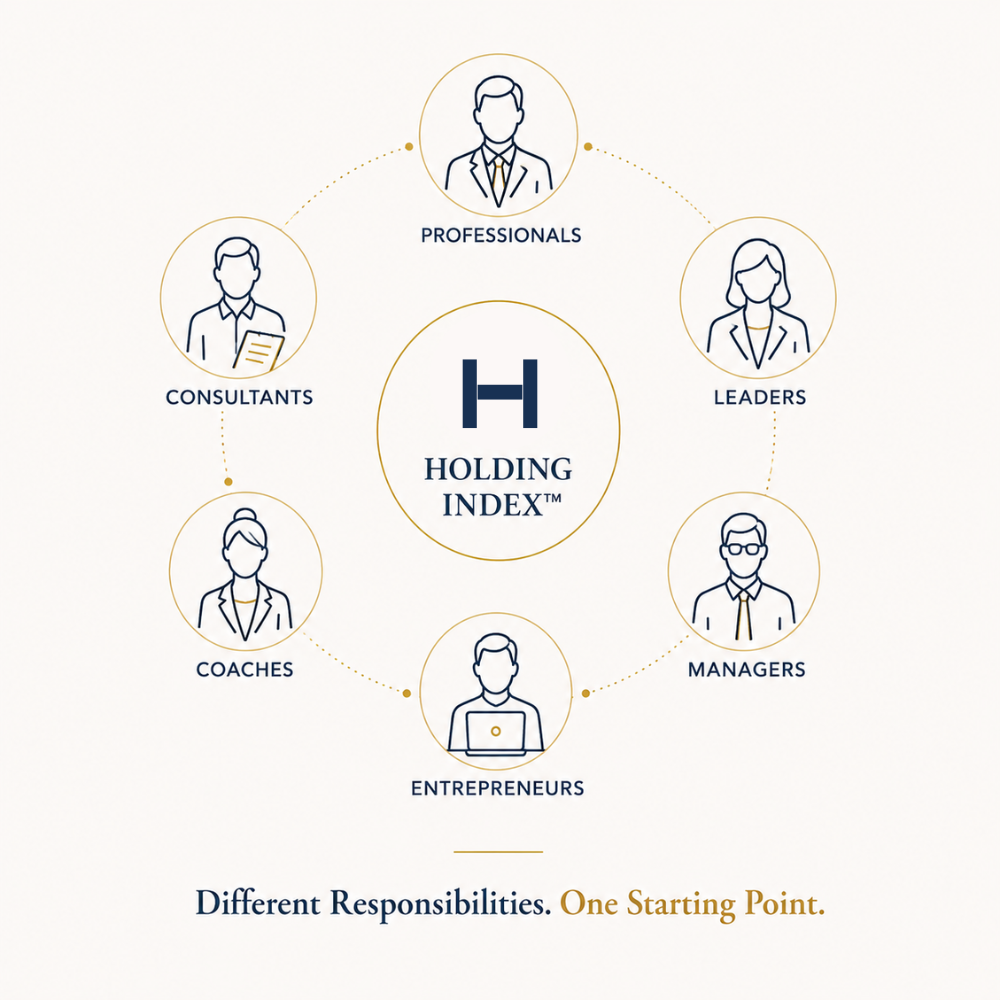
The Holding Index™ Snapshot is designed for individuals who recognise that professional judgement is continually influenced by changing responsibilities, expectations, and pressure.
Whether you are leading others, managing change, making important decisions, or simply wanting greater awareness, the Snapshot provides a structured starting point for deliberate professional development.
01
Professionals Carrying Greater Responsibility
Gain greater awareness of how increasing responsibility may be influencing judgement before the effects become visible.
02
Leaders and Decision
Makers
Recognise how pressure may be shaping reflection, proportion, and important decisions.
03
Individuals Navigating
Change
Understand how changing roles, priorities, or circumstances may be influencing professional judgement.
04
Professionals Seeking Self-Awareness
Develop a clearer understanding of your current judgement pattern before deciding where to focus further development.
05
Teams Beginning Their Development Journey
Use the Snapshot as a common starting point for building a shared language around judgement under pressure.
06
Anyone Curious About Current Holding Capacity™
Discover where your judgement is currently holding well and where deliberate attention may create the greatest improvement.
The Holding Index™ Snapshot is not designed to label people.
It is designed to create earlier awareness so that stronger judgement can be developed before pressure quietly becomes the new normal.
CHOOSE THE RIGHT ASSESSMENT
Begin With the Assessment
That Best Matches
Your Current Needs.
Both assessments are designed to strengthen awareness of how judgement is holding under pressure.
The Holding Index™ Snapshot provides a structured starting point.
The Professional Diagnostic™ builds on that foundation with deeper insight, personalised recommendations, and a more comprehensive understanding of your current judgement patterns.
Choose the assessment that best reflects where you are today.
01
Holding Index™ Snapshot
Complimentary
Recognition
Approximately 10 minutes
Holding Index™ Score
Current Judgement Pattern
Six Holding Systems™ Profile
Priority Holding System™
Professional Holding Profile™
Recommended Development Path
Best For: First-time awareness
02
Professional
Diagnostic™
Comprehensive
Recognition + Analysis
Approximately 20-25 minutes
Holding Index™ Score
Current Judgement Pattern
Six Holding Systems™ Profile
Priority Holding System™
Professional Holding Profile™
Recommended Development Path
Detailed Narrative Report
Deeper Domain Interpretation
Personalised Professional Guidance
Lifetime Professional Development Tool
Best For: Professionals Seeking Deeper Insight
Professional Diagnostic™
Designed to Grow With Your Professional Journey.
Unlike a one-time assessment, the Professional Diagnostic™ is designed to be used whenever your professional context changes.
You may choose to complete it monthly, following periods of significant responsibility, or whenever you feel your judgement is being tested by increased pressure or changing circumstances.
With Lifetime Access (₹1,999), you can return whenever you need renewed clarity—making the Professional Diagnostic™ an ongoing development tool rather than a one-time assessment.
Over time, repeated assessments allow you to observe how your judgement evolves, recognise emerging patterns, and track your professional development across changing situations.
Each assessment generates a new report based on your current responses, providing an up-to-date reflection of how your judgement is holding at that point in time.
Why Professionals Continue Using It
✓ Lifetime access with a one-time investment of ₹1,999
✓ Complete a fresh assessment whenever your professional circumstances change
✓ Every report reflects your current judgement, not previous responses
✓ Track how your judgement evolves over time
✓ Use before leadership transitions, major decisions, or periods of increased pressure
✓ Build a personal history of your professional development
Both assessments begin with the same purpose:
Helping you recognise how your judgement is currently holding under pressure.
The difference lies in the depth of insight provided.
FREQUENTLY ASKED QUESTIONS
Questions Professionals Often Ask Before They Begin.
Choosing to better understand your professional judgement is an important step.
These are some of the questions participants most commonly ask before completing the Holding Index™ Snapshot or the Professional Diagnostic™.
Professional judgement is continually influenced by changing circumstances.
The purpose of both assessments is to help you recognise those changes with greater clarity and proportion.
YOUR NEXT STEP
Begin With Awareness.
Build Professional Judgement Deliberately.
Every professional journey begins with recognition.
Whether you choose the complimentary Holding Index™ Snapshot or the more comprehensive Professional Diagnostic™, the most important step is beginning with an honest understanding of how your judgement is currently holding under pressure.
If you are exploring The Holding Discipline™ for the first time
The Holding Index™ Snapshot provides a structured introduction and helps identify where your professional development can begin.
If you are ready for deeper professional insight
The Professional Diagnostic™ offers a more comprehensive understanding of your judgement patterns and provides personalised guidance that can support your development over time.
If your judgement is already under pressure
There is no need to wait.
Complete the assessment that best matches your current needs and begin developing stronger judgement through deliberate awareness and reflection.
Professional judgement is rarely strengthened by chance.
It develops through deliberate recognition, thoughtful reflection, and consistent recalibration.
The first step is simply choosing to begin.
Both assessments exist for one purpose: helping you recognise how your judgement is currently holding under pressure, so you can respond with greater clarity, proportion, and confidence.
The Holding Index™
The Holding Index™
Professional judgement is not strengthened in a single decision.
It is strengthened through the discipline of recognising, reflecting, and responding well—one deliberate step at a time.— The Holding Discipline™