
THE HOLDING DISCIPLINE™
THE CONSTITUTIONAL ARCHITECTURE OF HOLDING™
The Constitutional Journey from Pressure to Holding™
Human capability is continually required to operate within changing context.
When context changes, capability can become compressed.
The Holding Discipline™ provides a way to recognise what is happening, understand what is changing, restore reliable judgement, express what has been developed, and continue without losing coherence.
ONE DISCIPLINE.
SIX HOLDING SYSTEMS™.
SEVEN OPERATING ENVIRONMENTS™.

EXPLORE THE ARCHITECTURE
Understand The Holding Discipline™.
The Holding Discipline™ is built as one continuing architecture.
Explore the sections below to understand why Holding is necessary, how the Discipline works, how the Six Holding Systems™ relate to the Seven Operating Environments™, and how the wider professional ecosystem fits together.
UNDERSTAND THE DISCIPLINE
→ What Is The Holding Discipline™?
→ Why Holding?
→ The Seven Books
→ How Holding Works
01 · UNDERSTAND THE DISCIPLINE
What Is The Holding Discipline™?
Human capability is continually required to operate within changing context.
Capability does not operate in isolation. It operates within conditions that continually change.
When context changes, what was previously accessible, proportionate or reliable may become harder to sustain.
The Holding Discipline™ begins with recognising this reality.
CAPABILITY
↓
CHANGING CONTEXT
↓
COMPRESSION
↓
HOLDING
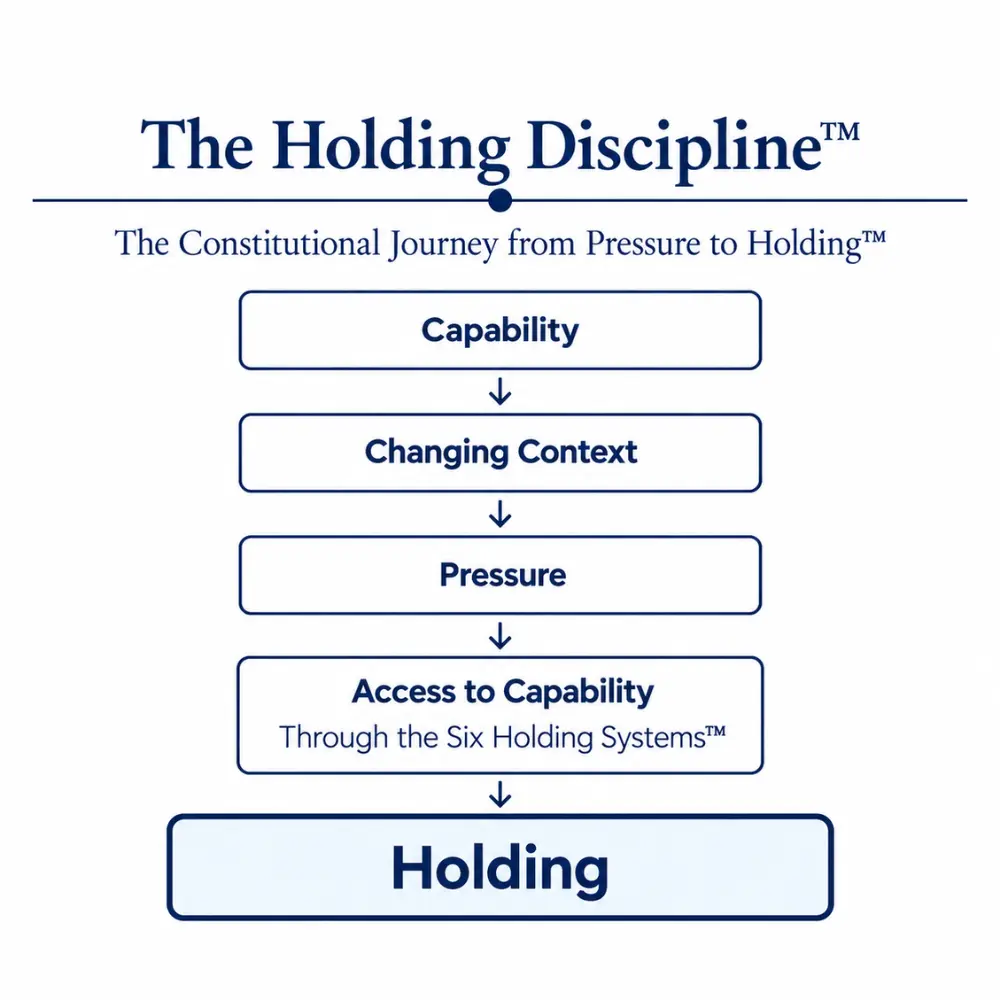
Holding is the capacity to maintain what must remain reliable while responding appropriately to what has changed.
Holding is not resistance to change.
Holding is the capacity to change without losing what must continue to hold.
Context™
Context™ is the total set of conditions within which human capability is required to operate.
Contexts continually change.
Holding exists because contexts continually change.
Perspective → Proportion → Judgement
The Holding Discipline™ is concerned with what happens between what we perceive, what significance we assign to it, and the judgement we ultimately exercise.
The Holding Discipline™ is one discipline expressed across different contexts.
Its six Holding Systems™ identify the dimensions in which capability may be affected.
Its seven Operating Environments™ provide the environments through which Holding can be recognised, developed, expressed, continued and applied.
02 · WHY HOLDING?
WHEN CONTEXT CHANGES,
CAPABILITY CAN BECOME COMPRESSED.
Human capability does not disappear simply because circumstances change.
But the conditions within which that capability has to operate may change.
What once worked may no longer work in the same way.
What was once accessible may become harder to access.
What once appeared proportionate may begin to feel normal even when the surrounding conditions have changed.
And what once seemed clear may become harder to judge.
This is where compression begins.
COMPRESSION DOES NOT ALWAYS
LOOK LIKE FAILURE.
Compression can happen while a person continues to perform.
A business can continue to grow while its capacity to carry that growth becomes strained.
A leader can continue to take responsibility while the conditions required for sound judgement become harder to maintain.
An innovation can continue to move forward while uncertainty changes what the original idea now has to carry.
A change can appear to have happened while its ability to continue becomes weaker.
Experience can remain extensive while its relevance to a changed context becomes less certain.
Capability may still be present.
But access to that capability can become compressed.
That distinction is central to The Holding Discipline™.
The first casualty is
PERSPECTIVE™.
It is easy to assume that judgement is the first thing affected when pressure increases.
The architecture begins earlier.
Perspective™
Perspective™ is the manner in which reality is perceived.
Perspective™ determines what enters in your conscious awareness.
It therefore establishes the beginning of every constitutional process.
What you perceive determines what becomes available to you for interpretation.
If something is not perceived, it cannot be proportionately interpreted.
What is not perceived cannot be proportionately interpreted.
Perspective precedes Proportion.
↓
The second casualty is
PROPORTION™.
Once perception becomes affected, the significance assigned to what has been perceived can also change.
Proportion™
Proportion™ is the significance assigned to what has been perceived.
It determines the relative importance, urgency and meaning attributed to what you experience.
The constitutional movement is therefore:
Reality
↓
Perspective
↓
Proportion
↓
Judgement
Distorted Proportion frequently precedes distorted Judgement.
↓
The third casualty is
JUDGEMENT™.
Judgement is not simply the ability to make a decision.
Judgement™
Judgement™ is the constitutional act of choosing
the most appropriate response from the capability presently accessible.
Judgement transforms accessible capability into intentional decision.
It deals with Operation.
Reliable judgement therefore depends upon reliable accessibility.
And reliable accessibility depends upon sound Perspective and Proportion.
Judgement represents the final constitutional reality preceding observable action.
It is therefore affected when Perspective and Proportion become compressed by changing context.
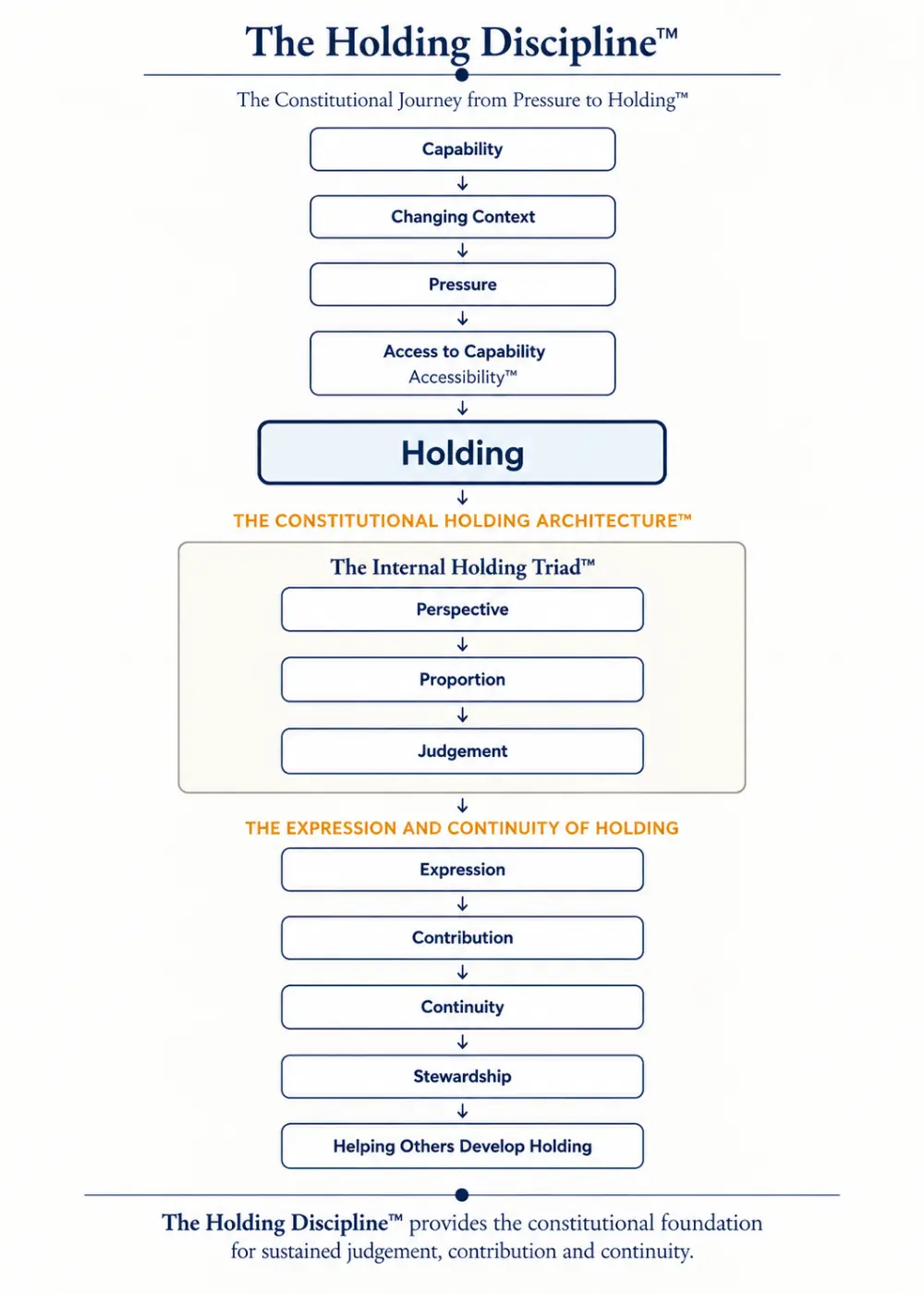
Distortion Cycle™
Reality influences Perspective.
Perspective influences Proportion.
Proportion influences Judgement.
Judgement influences Reality.
This is what Holding™ restores.
WHY HOLDING MATTERS
This is why Holding is not simply about becoming more capable.
It is about developing the capacity to continue accessing and exercising capability as conditions change.
The question is not only:
What capability do I have?
It is also:
Can I continue to access, interpret and exercise that capability when the context in which I need it changes?
That is the problem The Holding Discipline™ addresses.
HOLDING IS NOT
RESISTANCE TO CHANGE.
Holding does not mean keeping everything the same.
Context changes.
Responsibilities change.
Conditions change.
What must be protected may change.
What must be adapted may change.
What must continue to Hold must therefore be understood deliberately.
Holding is the capacity to respond to what has changed without losing what must continue to hold.
FROM COMPRESSION
TO RESTORATION
The Holding Discipline™ therefore works through a common constitutional movement:
Recognise what is happening.
↓
Restore Perspective.
↓
Restore Proportion.
↓
Restore Judgement.
↓
Develop Operational Capability.
This is why the first three Operating Environments are:
RESTORE HOLDING
Recognition™
Foundation™
Deep Application™
The Master Architecture establishes these as the three environments through which Perspective, Proportion and Judgement are progressively restored.
THE IMPORTANT DISTINCTION
Holding is therefore not a response reserved for when something has already failed.
It is a way of developing the capacity to remain reliable while context continues to change.
Because:
Contexts continually change.
Holding exists because contexts continually change.
And because context continues to change, the need for Holding continues.
THE ARCHITECTURAL MOVEMENT
CHANGING CONTEXT
↓
COMPRESSION
↓
PERSPECTIVE
↓
PROPORTION
↓
JUDGEMENT
↓
HOLDING
Holding does not remove change.
It develops the capacity to continue through change without losing what must Hold.
03 · THE SEVEN BOOKS
SEVEN BOOKS.
ONE DEVELOPING BODY OF THOUGHT.
The Holding Discipline™ did not begin as a finished system.
It developed through observation, experience, reflection and repeated examination of what happens when human capability meets changing context.
The seven books document that development.
They are not seven separate disciplines.
They are different expressions of one continuing inquiry:
How can human capability remain accessible, proportionate and useful as circumstances change?
Each book examines that question from a different point of view.
The Holding Discipline™ Library
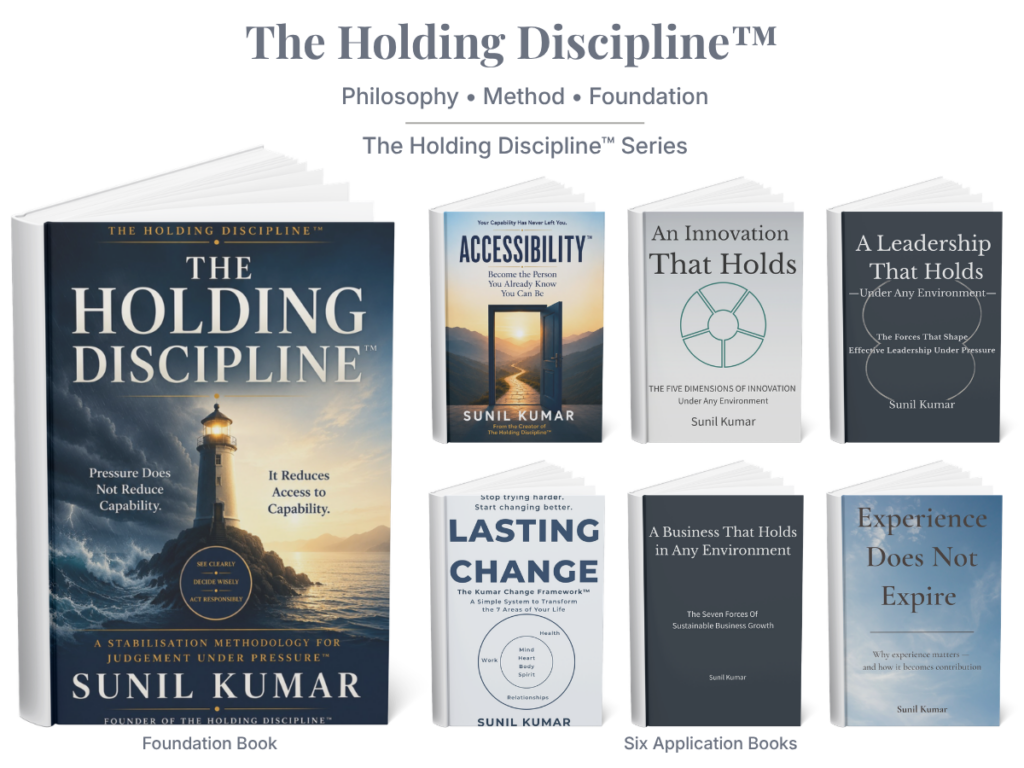
THE HOLDING DISCIPLINE™
The constitutional foundation.
The first book establishes the central question.
Human capability is continually required to operate within changing context.
Pressure can alter access to that capability.
Perspective can narrow.
Proportion can become distorted.
Judgement can become less reliable.
The book develops the constitutional foundation of Holding through the Internal Holding Triad™:
Perspective™ → Proportion™ → Judgement™
It establishes Holding not as a technique, but as a discipline through which capability can remain accessible under changing conditions.
ACCESSIBILITY™
The access to capability.
Capability and access to capability are not the same thing.
The book examines the distinction between what a person possesses and what is presently available to them.
Its central question is:
How reliably can capability be accessed when conditions change?
Accessibility therefore becomes a constitutional bridge within the wider Holding Discipline™.
It explains why capability may remain present while its reliable expression becomes more difficult.
LASTING CHANGE™
How change becomes sustainable.
Change does not become lasting simply because a new behaviour has been introduced.
The book examines the deeper conditions through which change becomes stable.
Its framework moves through connected movements from awareness and understanding through interruption, choice, repetition and environmental reinforcement.
The underlying proposition is simple:
Effort can create temporary improvement. Structure can create lasting change.
Lasting Change therefore examines what happens when behaviour and environment begin to support one another.
AN INNOVATION THAT HOLDS™
Holding direction under change.
Innovation is often understood as invention, disruption or breakthrough.
This book examines a different possibility.
Innovation can also be disciplined adjustment.
It can begin by noticing friction in the present and identifying where alignment has been lost.
The book develops innovation around five dimensions:
Offer → Access → Price → Experience → Communication
Its central concern is not how much change occurs.
It is whether change restores coherence.
Innovation holds when change is disciplined rather than dramatic.
A BUSINESS THAT HOLDS™
Holding judgement at operational scale.
Business growth changes what a business has to carry.
Demand increases.
Expectations multiply.
Decisions compound.
Responsibility expands.
The question therefore becomes more than whether a business can grow.
It becomes:
Can the business carry what growth creates?
A Business That Holds examines the relationship between growth, pressure, structure and proportion.
It distinguishes visible performance from structural holding.
A business may continue to perform while relying increasingly on compensation, improvisation or exceptional effort.
Holding asks what remains sound when those compensations are removed.
A LEADERSHIP THAT HOLDS™
Holding clarity under responsibility.
Leadership places human responsibility directly inside changing conditions.
Pressure can narrow judgement.
Success can delay recalibration.
Control can become concentrated.
Confidence can become insulation.
The book examines these conditions not simply as leadership behaviours, but as distortions that emerge when responsibility expands faster than the structures supporting it.
Its central concern is therefore:
How can leadership continue to exercise reliable judgement as responsibility increases?
Holding becomes a discipline of repeated recalibration rather than a quality that a leader either possesses or lacks. The book describes Holding as a repeated return to proportion under pressure.
EXPERIENCE DOES NOT EXPIRE™
When context changes, experience needs a new place to become useful.
Experience accumulates.
Context changes.
Relevance can therefore change without capability disappearing.
This book examines the distinction between:
Capability
and
Relevance.
Its central proposition is:
Experience remains intact, but it may need a new context to remain alive and useful.
The book therefore moves beyond the assumption that the end of a role means the end of contribution.
It asks what happens when accumulated experience has to find a new form of relevance, contribution and continuity.
THE BOOKS ARE NOT THE SYSTEM
The seven books should not be understood as seven separate systems.
They document the development and expression of one discipline.
The contexts differ.
The questions differ.
The forms of application differ.
But the constitutional concern remains.
Capability.
Changing Context.
Compression.
Accessibility.
Perspective.
Proportion.
Judgement.
Expression.
Contribution.
Continuity.
The discipline remains one.
Its expressions become many.
FROM BOOKS TO ARCHITECTURE
What began as inquiry became architecture.
The books provide the intellectual foundation.
The Six Holding Systems™ provide the contextual expressions.
The Seven Operating Environments™ provide the environments through which Holding can be recognised, developed, expressed, continued and applied.
Together they form a continuing architecture.
THE INTELLECTUAL MOVEMENT
ONE DISCIPLINE
↓
SEVEN BOOKS
↓
SIX HOLDING SYSTEMS™
↓
SEVEN OPERATING ENVIRONMENTS™
04 · HOW HOLDING WORKS
FROM INNER CAPABILITY
TO LASTING VALUE
The Holding Discipline™ begins with a simple recognition.
Human capability already exists.
The challenge is whether that capability remains accessible, proportionate and available for sound judgement when circumstances change.
Holding therefore does not begin with action.
It begins with seeing.
It develops through a continuing movement:
Perspective™ → Proportion™ → Judgement™
And what develops internally must eventually become useful externally:
Expression → Contribution → Continuity
This is how capability becomes something that can continue beyond the moment in which it was first developed.
THE INTERNAL HOLDING MOVEMENT
1 · PERSPECTIVE™
See What Is Actually Happening.
Perspective is the ability to see the situation before immediately reacting to it.
When pressure rises, what we see can narrow.
We may notice the most visible problem.
We may give greater significance to what feels urgent.
We may overlook what is changing underneath.
Holding begins by widening the field of view.
What am I seeing?
What am I not seeing?
2 · PROPORTION™
Understand What It Means.
Seeing is not enough.
The same situation can carry very different significance depending upon context.
Proportion helps distinguish what matters from what merely feels immediate.
It helps us understand:
- what is changing,
- what is stable,
- what is structural,
- what is temporary,
- and what requires attention now.
What significance should I attach to what I am seeing?
3 · JUDGEMENT™
Decide What Should Be Done.
Reliable judgement becomes possible when Perspective and Proportion are sufficiently developed.
Judgement is not simply choosing quickly.
It is deciding appropriately.
It asks:
What response is proportionate to what is actually happening?
This is where Holding becomes practical.
The purpose is not to eliminate uncertainty.
It is to preserve the quality of judgement within it.
FROM INNER DEVELOPMENT TO OUTER EXPRESSION
Developing Perspective, Proportion and Judgement is not the end.
Capability becomes valuable when it can be expressed.
The external movement therefore continues:
Expression → Contribution → Continuity
EXPRESS HOLDING
4 · EXPRESSION
Make Judgement Visible.
Expression is where internal development becomes observable.
Judgement becomes a decision.
Understanding becomes behaviour.
Capability becomes something that can influence the world beyond the individual.
But expression is not simply action.
It is judgement expressed appropriately in context.
5 · CONTRIBUTION
Make What You Develop Useful To Others.
Expression becomes contribution when what has been developed creates value beyond the self.
Contribution is capability shared.
It may take the form of:
- solving a problem,
- developing another person,
- improving a system,
- creating something useful,
- or making experience available in an appropriate form.
The question changes from:
What can I do?
to:
What can what I have developed make possible for someone else?
6 · CONTINUITY
Allow Value To Continue.
Contribution becomes continuity when its value no longer depends entirely upon the person who first created it.
Knowledge can continue.
Capability can continue.
A system can continue.
A contribution can continue.
Continuity therefore moves Holding beyond individual performance.
It asks:
What remains useful after I step back?
APPLY HOLDING
THE SEVENTH ENVIRONMENT
PRECISION INTERVENTION™
Focus On What Requires Attention Now.
Not every situation requires the full developmental journey.
Sometimes something specific requires concentrated attention.
Precision Intervention™ provides that focused professional intervention.
It begins with the situation itself rather than requiring someone to move through a predetermined framework.
It can therefore be accessed independently:
before, during or after engagement with other environments.
It is not a compulsory final stage.
It is a focused response to a specific situation that requires attention.
ONE DISCIPLINE. DIFFERENT MOVEMENTS.
The movement is therefore not a rigid ladder.
It is a continuing Holding architecture.
PERSPECTIVE™
See.
↓
PROPORTION™
Understand.
↓
JUDGEMENT™
Decide.
↓
EXPRESSION
Make visible.
↓
CONTRIBUTION
Make useful.
↓
CONTINUITY
Allow it to continue.
And when something specific requires concentrated attention:
PRECISION INTERVENTION™
The Holding Discipline™ does not require everyone to begin in the same place.
You begin where the situation requires.
You develop what needs to develop.
And you continue from there.
The architecture explicitly treats the pathway as a holding highway rather than a fixed sequence.
05 · SIX HOLDING SYSTEMS™
ONE DISCIPLINE.
SIX HOLDING SYSTEMS™.
The Holding Discipline™ is one.
But human capability does not operate in one context.
The conditions within which Holding is required differ.
The questions change.
The pressures change.
The forms of responsibility change.
The way capability needs to be expressed therefore changes.
The six Holding Systems™ provide different contextual expressions of the same constitutional discipline.
They are not six separate disciplines.
They are six ways of understanding and developing Holding within different conditions.
THE SIX SYSTEMS
BEFORE CONTEXT
01 · ACCESSIBILITY™
Before Capability Can Be Reliably Used
Accessibility™ concerns access to capability.
Capability may exist without being reliably accessible.
When conditions change, pressure can affect what a person can actually access, interpret and use.
Accessibility™ therefore provides the constitutional bridge between capability and Holding.
It asks:
Can the capability that exists remain accessible when conditions change?
DURING CONTEXT
02 · LASTING CHANGE™
When Something Needs To Change And Continue
Change introduces a different constitutional requirement.
It is not enough for something to change once.
The change must become capable of continuing within the conditions in which it has to live.
Lasting Change™ examines how behaviour, environment and repeated practice interact so that change becomes sustainable rather than temporary.
It asks:
How can change continue when the conditions surrounding it continue to change?
DURING CONTEXT
03 · INNOVATION™
When Something New Needs To Become Coherent
Innovation introduces possibility.
But possibility alone does not create Holding.
An innovation must remain connected to the conditions in which it is intended to operate.
Innovation™ therefore examines how new possibilities can be developed while maintaining coherence between what is being created and what the context requires.
It asks:
How can something new be developed without losing coherence with what it needs to Hold?
DURING CONTEXT
04 · BUSINESS™
When Growth Increases What Must Be Carried
Business introduces scale, responsibility and increasing interdependence.
Growth can create more customers, more decisions, more people, more expectations and more responsibility.
The question is therefore not simply whether a business can grow.
It is:
Can the business carry what growth creates?
Business™ applies the Holding Discipline™ to the conditions through which sustainable value has to be created and carried.
DURING CONTEXT
05 · LEADERSHIP™
When Responsibility Is Carried Through Other People
Leadership places judgement inside relationships, responsibility and influence.
As responsibility increases, the conditions surrounding judgement also change.
Leadership™ examines how Holding can support responsible judgement when a person must influence, decide and act through the lives and work of others.
It asks:
How can leadership continue to exercise reliable judgement as responsibility increases?
AFTER CONTEXT
06 · EXPERIENCE™
When Capability Has To Remain Relevant As Context Changes
Experience accumulates.
But context changes.
Experience can therefore remain valuable while its relevance, expression or application changes.
Experience™ examines how accumulated capability can continue to become useful as circumstances, responsibilities and environments change.
It asks:
How can experience continue to contribute when the context in which it was developed changes?
THE SIX ARE CONNECTED
These systems should not be understood as isolated subjects.
They sit within a wider constitutional architecture.
BEFORE CONTEXT
Accessibility™
The question of whether capability can be accessed.
DURING CONTEXT
Lasting Change™
Innovation™
Business™
Leadership™
Different conditions in which Holding is actively being expressed.
AFTER CONTEXT
Experience™
The question of how accumulated capability continues to remain useful as context changes.
SIX CONTEXTS.
ONE DISCIPLINE.
The context changes.
The discipline does not.
The same constitutional realities remain:
Capability.
Changing Context.
Pressure.
Perspective.
Proportion.
Judgement.
Expression.
Contribution.
Continuity.
What changes is the environment in which those realities have to be held.
This is why the six Holding Systems™ are different without being separate.
THE ARCHITECTURAL RELATIONSHIP
The relationship can therefore be seen simply:
ONE HOLDING DISCIPLINE™
↓
SIX HOLDING SYSTEMS™
↓
DIFFERENT CONTEXTS
↓
ONE CONSTITUTIONAL REALITY
The discipline remains one.
Its expression changes with context.
06 · SEVEN OPERATING ENVIRONMENTS™
ONE HOLDING DISCIPLINE.
SEVEN OPERATING ENVIRONMENTS™.
The Holding Discipline™ is one continuing discipline.
The six Holding Systems™ describe the different contexts in which that discipline is expressed.
The Operating Environments™ describe the different environments through which Holding can be recognised, developed, expressed, continued and applied.
They are not seven compulsory stages.
They are not seven separate products.
They are different environments within one continuing Holding architecture.
THE SEVEN OPERATING ENVIRONMENTS™
RESTORE HOLDING
The first three environments concern restoration.
They progressively develop the internal conditions required for reliable Holding.
01 — Recognition™
Restore Perspective.
Recognition makes what may otherwise remain difficult to explain visible.
It helps you see what is happening before deciding what to do about it.
Recognition is where development begins.
↓
02 — Foundation™
Restore Perspective and Proportion.
Foundation develops constitutional understanding.
You explore what influences the system, what allows it to remain stable, and what must Hold.
Foundation gives structure to what Recognition makes visible.
↓
03 — Deep Application™
Restore Perspective, Proportion and Judgement.
Deep Application moves beyond understanding into structured application.
You develop the ability to operate with the Holding System™ while conditions are actually changing.
It is where constitutional understanding becomes operational capability.
These are the first three Operating Environments of The Holding Discipline™.
These environments help restore the internal conditions required for reliable judgement.
But restoration is of no Value Unless Expressed.
Holding has to be expressed to be meaningful.
EXPRESS HOLDING
The next three environments concern expression.
What has been developed internally must become capable of being expressed, shared and continued.
04 — Grow & Hold™
Expression for Self.
Express Holding Through Your Own Responsibilities.
Grow & Hold™ applies The Holding Discipline™ to the responsibilities, ambitions, commitments and circumstances that are changing.
Growth increases what must be carried.
Holding develops the capacity to carry what growth introduces.
05 — Contribution™
Expression for Others.
Make What You Develop Useful To Others.
Contribution develops the ability to turn what you have developed into something genuinely useful, appropriate and responsible.
Contribution is where capability begins to move beyond the individual.
It may be expressed through solving a problem, developing another person, improving a system, creating something useful or making experience available in an appropriate form.
The journey of Expression Continues.
06 — Holding Circle™
Continuity, Stewardship and
Helping Others Develop Holding.
Holding Circle™ provides the continuing professional environment for practice, recalibration, contribution, stewardship and further development.
It is also an environment in which you can help others develop Holding.
Development therefore does not end when capability has been established.
It continues as conditions, responsibilities and contribution change.
These are the Next three Operating Environments of The Holding Discipline™.
These environments support the expression of Holding in life, responsibility, contribution and continuity.
You may have a specific situation, which requires immediate attention to apply holding.
APPLY HOLDING
There is one further environment.
It is deliberately different.
07 — Precision Intervention™
Focus On What Requires Attention Now.
A focused, independent professional intervention for a specific situation.
Not every situation requires the full developmental journey.
Sometimes something specific requires concentrated attention.
Precision Intervention™ is a focused one-to-one professional intervention for a situation that requires it.
It begins with the situation itself rather than requiring someone to move through a predetermined framework.
It can therefore be accessed independently:
before, during or after engagement with other environments.
It is not a compulsory final stage.
It is a focused response to a specific situation that requires attention.
It is the seventh Operating Environment — a specialised point of intervention rather than a compulsory next stage.
ONE ARCHITECTURE.
DIFFERENT ENTRY POINTS.
The seven environments therefore do not form a rigid ladder.
They form a continuing Holding architecture.
You can enter where it is relevant.
You develop what needs to develop.
You express what has become useful.
You continue from there.
And when something specific requires concentrated attention, Precision Intervention™ can be accessed independently.
THE SEVEN ENVIRONMENTS IN RELATION
RESTORE HOLDING
01 Recognition™
See what is happening.
↓
02 Foundation™
Understand the System.
↓
03 Deep Application™
Develop operational capability.
EXPRESS HOLDING
04 Grow & Hold™
Express Holding through your own responsibilities.
↓
05 Contribution™
Make what you develop useful to others.
↓
06 Holding Circle™
Continue developing within The Holding Discipline™.
APPLY HOLDING
07 Precision Intervention™
Focus on what requires attention.
SEVEN OPERATING ENVIRONMENTS™.
ONE CONTINUING DISCIPLINE.
The environments differ.
The contexts differ.
The point of entry may differ.
But the discipline remains one.
The Holding Discipline™ provides the constitutional foundation.
The Holding Systems™ provide the contextual expressions.
The Operating Environments™ provide the environments through which Holding can be developed, expressed, continued and applied.
The Holding Discipline™
Restore what pressure compresses.
Express what has been restored.
Continue what matters.
Perspective → Proportion → Judgement → Expression → Contribution → Continuity → Stewardship → Helping Others Develop Holding
Continuity is like a journey on a highway. You decide how you want to go. The path remains.
07 · THE PROFESSIONAL ECOSYSTEM
THE PROFESSIONAL ECOSYSTEM™
The Holding Discipline™ does not exist as a single course, book or intervention.
It is expressed through a wider professional ecosystem.
The ecosystem allows different people to engage with the Discipline™ at different levels, for different purposes and with different degrees of depth.
THE SEVEN BOOKS™
The seven books provide the intellectual foundation.
They document the development of the underlying body of thought.
RECOGNITION™
THE HOLDING INDEX™
The Holding Index™ provides a starting point for recognising what may be happening.
It helps make pressure, compression and changing conditions visible before deciding what to develop.
↓
FOUNDATION™
FOUNDATION COURSES
Foundation develops constitutional understanding of the Holding Systems™.
Each course explores one contextual expression of The Holding Discipline™.
↓
DEEP APPLICATION™
DEEP APPLICATION COURSES
Deep Application develops the ability to operate with a Holding System™ while conditions are actually changing.
Understanding becomes structured operational capability.
↓
GROW & HOLD™
GROW YOUR BUSINESS & HOLD™
Grow Your Business & Hold™ applies Holding to the conditions created by growth.
Growth expands what a business is asked to carry.
Holding develops the capacity to carry it.
↓
CONTRIBUTION™
PROFESSIONAL CONTRIBUTION
Contribution is where developed capability becomes useful to others.
It may be expressed through professional work, developing others, improving systems, creating something useful or making experience available in an appropriate form.
↓
Holding Circle™
CONTINUING PROFESSIONAL DEVELOPMENT
Holding Circle™ provides the continuing professional environment for practice, recalibration, contribution, stewardship and further development.
It is where development continues rather than ends.
↓
Precision Intervention™
FOCUSED PROFESSIONAL INTERVENTION
Some situations require concentrated attention rather than a broader developmental journey.
Precision Intervention™ provides a focused one-to-one professional intervention for a specific situation.
It can be accessed independently.
ONE DISCIPLINE.
DIFFERENT WAYS TO ENGAGE.
You do not have to begin everywhere.
You begin where your situation requires.
You develop what needs to develop.
You contribute what has become useful.
And you continue from there.
THE HOLDING DISCIPLINE™
Recognise. Develop. Express. Continue.
08 · HOLDING AS A WAY OF LIFE™
HOLDING AS A WAY OF LIFE™
The Holding Discipline™ ultimately concerns more than developing capability for a particular situation.
It concerns how capability is carried through life as conditions continue to change.
Holding therefore becomes less about applying a framework and more about developing a way of seeing, understanding, deciding, expressing and continuing.
HOLDING BECOMES
A WAY OF SEEING
Context changes.
Pressure changes.
Responsibilities change.
What once appeared clear may require reconsideration.
What once worked may require adaptation.
Holding begins with recognising what is actually happening before deciding what should be done.
Perspective precedes Proportion.
HOLDING BECOMES
A WAY OF UNDERSTANDING
Not everything that changes requires the same response.
Some things need to be protected.
Some things need to change.
Some things need to be developed.
Some things need to be released.
Holding requires the ability to distinguish between them.
Proportion precedes Judgement.
HOLDING BECOMES
A WAY OF DECIDING
Judgement is not simply choosing quickly.
It is choosing appropriately.
The purpose of Holding is not to eliminate uncertainty.
It is to preserve the quality of judgement within uncertainty.
Judgement precedes responsible action.
HOLDING BECOMES
A WAY OF EXPRESSING
What is developed internally eventually has to become useful externally.
Understanding becomes behaviour.
Judgement becomes decision.
Capability becomes contribution.
Expression is therefore not separate from Holding.
It is one of the ways Holding becomes visible.
HOLDING BECOMES
A WAY OF CONTINUING
What has become useful should not depend entirely upon the person who first developed it.
Knowledge can continue.
Capability can continue.
Contribution can continue.
A system can continue.
This is where Holding moves beyond individual performance into continuity.
THE DISCIPLINE REMAINS ONE
The contexts change.
The responsibilities change.
The environments change.
The point of entry may change.
The expression may change.
But the constitutional reality remains.
Capability.
Changing Context.
Compression.
Accessibility.
Perspective.
Proportion.
Judgement.
Expression.
Contribution.
Continuity.
HOLDING IS NOT
THE ABSENCE OF CHANGE
Holding does not mean keeping everything the same.
It means developing the capacity to respond to what has changed without losing what must continue to Hold.
The work therefore never becomes simply:
How do I maintain what I have?
It becomes:
How do I continue to remain reliable as the conditions in which I must operate change?
THE HOLDING DISCIPLINE™
Restore what pressure compresses.
Express what has been developed.
Continue what matters.
The discipline remains one.
The contexts change.
The work continues.
YOUR NEXT STEP
GROW.
HOLD WHAT MATTERS.
CONTINUE.
Your business will continue to change.
Your responsibilities will continue to change.
The situations you face will continue to change.
Your capacity can continue to develop.
Start where you are.
Develop what you need.
Continue from there.
Everything changes under pressure.
The question is not whether pressure changes you—but whether your judgement continues to hold.”
— The Holding Discipline™