
ABOUT SUNIL KUMAR
THE EXPERIENCE BEHIND
THE HOLDING DISCIPLINE™
Developed through decades of responsibility, changing conditions and decisions made under pressure.
Sunil Kumar’s work began inside the systems he was responsible for leading — not in theory, but through lived experience of how pressure, changing circumstances and responsibility affect judgement.
Government of India
Indian Telecommunication Services
37 Years
Chairman & Managing Director
Government of India Navratna Enterprise

One question changed the direction of the work.
Why do capable people sometimes lose reliable access to their capability when life becomes difficult?
EXPLORE ABOUT SUNIL KUMAR
THE ENVIRONMENT
BUILT WHERE PRESSURE WAS REAL
Sunil Kumar’s professional life unfolded inside a large public-sector telecommunications organisation during a period of profound change.
He began his career in a protected, monopolistic environment.
Over the years, that environment changed.
Competition emerged.
Technology accelerated.
Expectations changed.
Structures were redesigned.
Responsibilities expanded.
He experienced reform, resistance, expansion, restructuring, acceleration and leadership transition — not as an observer, but as an accountable decision-maker.
At different points, the work required more than technical knowledge.
It required decisions within systems shaped by policy, scale, uncertainty and consequence.
Pressure was not an unusual event that appeared occasionally.
It was part of the environment in which judgement had to operate.
And that distinction matters.
Because when conditions change, the question is not simply whether a person is capable.
The question becomes:
Can the capability they already possess remain accessible when responsibility increases and circumstances become more difficult?
THE ENVIRONMENT CHANGED.
THE QUESTION DEEPENED.
The experience of working through changing conditions did not immediately produce a theory.
It produced observations.
And one experience, in particular, stayed with him.
Five minutes.
One objection.
One reaction.
One question that would remain for years.
THE EXPERIENCE
THE FIVE MINUTES THAT CHANGED THE QUESTION
At that stage of my career, I was serving as Chairman and Managing Director.
Our organisation was carrying significant responsibilities. Like any senior leader, I was making decisions, reviewing proposals, balancing priorities and trying to move important work forward.
One particular proposal had taken considerable effort to develop.
Many discussions had taken place.
Many people had contributed.
It had finally reached the stage where I expected it to move forward.
Instead, an objection was raised.
The Director (Finance) had recorded his concerns.
I reacted immediately.
I called him to my office.
The conversation that followed was not one of my better moments.
I spoke sharply.
Much more sharply than the situation deserved.
For several minutes, I expressed my frustration.
He listened quietly.
He did not interrupt.
He did not defend himself.
He simply listened.
Then something happened that I have never forgotten.
He calmly asked for a glass of water.
He took a sip, looked at me and explained that he had not understood the implications of the proposal.
That was all.
There was no confrontation.
No argument.
No attempt to justify himself.
He simply had not seen what I was seeing.
I explained the larger purpose behind the proposal.
Within a few minutes, he understood.
He revised his remarks.
The objection disappeared.
The proposal moved forward.
The entire incident lasted only a few minutes.
From the outside, it was an ordinary workplace episode.
But something inside me refused to move on.
THE QUESTION
Why had I reacted the way I did?
The Director had not intended to create a problem.
He had simply not understood what I understood.
Once he did, everything changed.
Yet before that understanding, I had become a different version of myself.
And I could not explain why.
That question stayed with me.
Not for days.
For years.
The experience is documented in Accessibility™ as the five-minute incident. I would not understand the significance of those five minutes for many years.
THE INCIDENT ENDED.
THE QUESTION DID NOT.
What remained was not the objection.
It was the discovery that, for a few minutes, the judgement I already possessed had not been fully available to me.
THE DISCOVERY
PERHAPS PRESSURE DOES NOT REDUCE CAPABILITY
For a long time, I thought the answer might lie in capability.
Perhaps people needed to learn more.
Perhaps they needed more experience.
Perhaps they needed greater discipline.
Certainly, capability matters.
We should continue learning.
We should continue developing.
We should continue gaining experience.
But my own experience kept pointing towards something else.
People who clearly possess knowledge, experience and judgement did not always have reliable access to them when life became demanding.
The capability was still there.
But access to it could change.
That possibility changed the question I was asking.
Instead of asking:
What is wrong with the person?
I began asking:
What makes the best within a person temporarily unavailable?
And gradually another possibility emerged.
Perhaps pressure does not reduce capability.
Perhaps it reduces access to capability.
That distinction became foundational to my work.
THE POSSIBILITY
If capability remains, then the situation is not necessarily one of deficiency.
Something else may be happening.
The task is not always to create more capability.
Sometimes it is to understand what is interfering with access to the capability already present.
That insight opened a different way of looking at leadership, change, business, innovation, experience — and eventually, at human life itself.
The environments were different.
The pattern was remarkably similar.
THE CAPABILITY MAY REMAIN.
THE ACCESS MAY CHANGE.
That became the beginning of a much larger inquiry.
And eventually, that inquiry became The Holding Discipline™.
THE IDEA
THE WORLD DOES NOT NEED MORE CAPABLE PEOPLE.
It needs more people whose capability remains accessible when life becomes difficult.
For me, this changed the purpose of the work.
The question was no longer simply how people become more capable.
It became a different question:
How can capability remain accessible as life changes?
Because life does not remain still.
Responsibilities grow.
Circumstances change.
Pressure arrives.
Relationships evolve.
Organisations transform.
Experience accumulates.
And the person who was capable yesterday may encounter conditions tomorrow in which that same capability becomes harder to access.
The answer, I came to believe, was not another promise of perfection.
It was the development of a way of Holding.
A way of remaining connected to Perspective, Proportion, Accessibility and Judgement while circumstances continue to change.
THE SHIFT
FROM BECOMING MORE CAPABLE
TO REMAINING ACCESSIBLE TO THE CAPABILITY YOU ALREADY HAVE.
That became the direction of my work.
And it gradually led to a larger question:
What would it take to develop this as a discipline — rather than leave it as an insight?
The answer became The Holding Discipline™.
Not a technique for avoiding pressure.
Not a promise that difficult circumstances will disappear.
But a discipline for understanding how human capability can remain reliably accessible as life continues changing.
THE DISCIPLINE
FROM A QUESTION TO A DISCIPLINE
The Holding Discipline™ did not emerge as a theory I set out to create.
It developed gradually.
Through observation.
Reflection.
Experience.
Questions that refused to leave.
The original question kept returning:
Why do capable people sometimes become temporarily inaccessible to the best within themselves?
Over time, the question became more than something to answer.
It became a way of observing life.
Different situations revealed different expressions of the same underlying reality.
Pressure could narrow Perspective.
Changing circumstances could disturb Proportion.
Accessibility could reduce.
Judgement could become less reliable.
Yet capability itself had not necessarily disappeared.
The work therefore moved beyond the question of how to become more capable.
It became an inquiry into how capability can remain reliably accessible as life continues changing.
That inquiry became The Holding Discipline™.
NOT ANOTHER METHOD
The Holding Discipline™ is not presented as a technique for controlling life.
It is not a promise that pressure can be eliminated.
And it is not a formula for perfect judgement.
It is a discipline for understanding and developing the constitutional realities that allow human capability to remain accessible under changing conditions.
At its centre are four realities:
Perspective.
How we see.
Proportion.
How we understand significance.
Accessibility.
What capability is presently available to us.
Judgement.
How we decide and respond.
Together, they provide a way of understanding what happens to capability when context changes.
The discipline remains one.
Its expressions become many.
FROM ONE DISCIPLINE TO MANY EXPRESSIONS
That is why the work eventually moved into different environments:
Accessibility™
Lasting Change™
Innovation™
Business™
Leadership™
Experience™
And the work continued into a seven-book body of thought — one discipline expressed through different environments.
These are not separate disciplines.
They are different environments in which the same underlying realities are expressed.
What began with one difficult moment became a continuing body of work.
One question.
One discipline.
Many expressions.
And the work continues.
THE BODY OF WORK
SEVEN BOOKS.
ONE CONTINUING INQUIRY.
The question did not end with The Holding Discipline™.
It continued.
Each book explored the same constitutional realities through a different environment.
What initially appeared to be separate subjects gradually revealed a common foundation:
Holding.
The seven books are therefore not seven unrelated works.
They are one continuing inquiry into how human capability remains accessible, useful and enduring as circumstances change.
THE SEVEN BOOKS
Available on Amazon for Purchase.
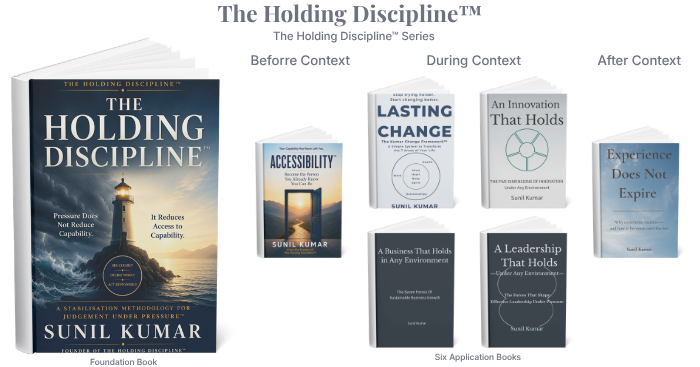
01 — THE HOLDING DISCIPLINE™
The constitutional foundation.
The book from which the discipline is articulated: capability, changing context, pressure, Holding, Perspective, Proportion, Accessibility and Judgement.
02 — ACCESSIBILITY™
The question of access to capability.
The exploration that asks what happens when capability exists but is not reliably available when it is needed.
03 — LASTING CHANGE™
How change becomes sustainable.
The work extends Holding into the environment of personal and organisational change.
04 — AN INNOVATION THAT HOLDS™
How innovation survives beyond the moment of invention.
Holding expressed through creating something new while preserving what needs to remain.
05 — A BUSINESS THAT HOLDS™
How growth becomes something that can be carried.
Holding expressed through business, value creation, increasing responsibility and changing conditions.
06 — A LEADERSHIP THAT HOLDS™
How leadership remains reliable as responsibility increases.
Holding expressed through leadership, pressure, alignment, judgement and continuity.
07 — EXPERIENCE DOES NOT EXPIRE™
How experience remains useful as context changes.
Holding expressed through experience, relevance, adaptation and continued contribution.
THE CONNECTION
Seven books.
Different environments.
One underlying discipline.
The discipline remains one.
Its expressions become many.
That understanding changed the way I saw the work.
I no longer saw seven separate books.
I saw one continuing conversation.
The books became the foundation.
The work continued beyond them.
BEYOND THE BOOKS
THE WORK CONTINUES BEYOND THE PAGE
The books became the foundation.
But a discipline cannot remain only in books.
It has to be understood.
Practised.
Developed.
Applied.
And eventually, shared.
The Holding Discipline™ therefore continued beyond the seven books into a wider set of environments through which people can encounter, develop and express Holding.
The purpose is not to create more products around the books.
It is to create places where the discipline can continue to live.
FROM KNOWLEDGE TO DEVELOPMENT
Reading can introduce an idea.
But understanding deepens when the idea is examined.
Capability develops when it is practised.
And Holding becomes more reliable when it is carried into real conditions.
That is why the work now extends across different ways of engaging:
THE SEVEN OPERATING ENVIRONMENTS™
RESTORE HOLDING
The first three environments concern restoration.
They progressively develop the internal conditions required for reliable Holding.
01 — Recognition™
Restore Perspective.
Seeing what is happening.
02 — Foundation™
Restore Perspective and Proportion.
Understanding the system.
03 — Deep Application™
Restore Perspective, Proportion and Judgement.
Developing operational capability.
These are the first three Operating Environments of The Holding Discipline™.
These environments help restore the internal conditions required for reliable judgement.
But restoration is of no Value Unless Expressed.
Holding has to be expressed to be meaningful.
EXPRESS HOLDING
The next three environments concern expression.
What has been developed internally must become capable of being expressed, shared and continued.
04 — Grow & Hold™
Expression for Self.
Expressing what has been developed.
05 — Contribution™
Expression for Others.
Making that development useful to others.
The journey of Expression Continues.
06 — Holding Circle™
Continuity, Stewardship and
Helping Others Develop Holding.
Continuing to develop within the Discipline.
These are the Next three Operating Environments of The Holding Discipline™.
These environments support the expression of Holding in life, responsibility, contribution and continuity.
You may have a specific situation, which requires immediate attention to apply holding.
APPLY HOLDING
There is one further environment.
It is deliberately different.
07 — Precision Intervention™
A focused, independent professional intervention for a specific situation.
Giving focused attention to what requires it.
These are seven Operating Environments™ within one continuing Holding journey — not seven compulsory stages or seven unrelated products.
A WIDER PROFESSIONAL ECOSYSTEM
The work has also developed into a professional ecosystem through which different people can engage with Holding according to what they are trying to develop.
Some may begin with understanding.
Some may want structured development.
Some may want assessment.
Some may want to practise professionally.
Some may want to contribute to the continuing development of the Discipline itself.
The routes may differ.
The constitutional foundation remains the same.
The Professional Ecosystem exists to make those different forms of engagement possible without fragmenting the Discipline.
THE PRINCIPLE
ONE DISCIPLINE.
DIFFERENT WAYS TO ENGAGE.
That principle has become increasingly important as the work has developed.
The aim is not simply to reach more people.
It is to create environments in which people can develop Holding with increasing depth, responsibility and continuity.
The books opened the inquiry.
The architecture gives it structure.
The environments give it somewhere to live.
And the work continues through the people who practise it.
THE CONTRIBUTION
WHAT I AM TRYING TO LEAVE BEHIND
I have never thought of this work simply as a collection of books.
The books were where the ideas were developed, examined and expressed.
The larger purpose is different.
It is to help people remain more reliably connected to their own capability while life continues to change around them.
Because responsibility does not remain constant.
Conditions change.
Pressure changes.
Relationships change.
Organisations change.
Experience changes.
And the person we become through one period of life still has to meet the circumstances of the next.
That is why I believe development cannot be something we complete.
It has to remain alive.
NOT PERFECTION
I am not trying to create people who never lose perspective.
Or people who never make mistakes.
Or people who never experience pressure.
That would not be realistic.
Holding does not remove uncertainty.
It does not eliminate pressure.
It does not promise perfect judgement.
It offers something more practical:
the possibility of remaining more reliably connected to capability while circumstances continue changing.
That possibility is what I have spent much of my professional and intellectual life trying to understand.
FROM MY EXPERIENCE
TO A SHARED DISCIPLINE
What began as a question from my own experience eventually became a discipline that I believe can be developed by others.
That matters to me.
Because a discipline becomes meaningful only when it can move beyond the person who first articulated it.
It should be possible for another person to encounter the idea, question it, practise it, develop through it — and eventually express it in their own circumstances.
The future of the work therefore cannot depend upon one author.
It depends upon people who choose to live its principles.
That is the deeper meaning of stewardship behind the work.
THE THOUGHT
I WANT TO LEAVE WITH THE READER
LEAVE SOMETHING STRONGER
THAN YOU FOUND IT.
Not because it belongs to you.
But because it may one day help someone you will never meet.
That is perhaps the simplest way I can describe what I am trying to contribute.
The work began with a question about my own judgement.
It became a discipline.
It became seven books.
It became an architecture.
And now it continues through the people who choose to develop and practise it.
The work continues.
CONTINUE THE WORK
WHERE WOULD YOU LIKE TO BEGIN?
The Holding Discipline™ can be encountered in different ways.
You may want to understand the constitutional foundation.
You may want to explore the seven books.
You may want to see how the Discipline is organised.
Or you may be ready to begin developing it in your own circumstances.
There is no single starting point.
Choose the one that is right for where you are now.
FOUR PATHWAYS
01
THE HOLDING DISCIPLINE™
Understand the constitutional foundation.
Explore the ideas, principles and architecture from which the work has developed.
02
THE SEVEN
BOOKS
Explore the continuing body of thought.
Seven books. One Discipline. Different environments through which the inquiry has developed.
03
THE HOLDING ARCHITECTURE™
See how the Discipline is organised.
Explore the six Holding Systems™, seven Operating Environments™ and the wider architecture of the work.
04
BEGIN YOUR OWN DEVELOPMENT
Find your way into the work.
Explore the available ways to recognise, understand, develop, express and continue Holding in your own circumstances.
The world does not need more capable people.
It needs more people whose capability remains accessible when life becomes difficult.— Sunil Kumar, Founder of The Holding Discipline™